
They seem to be overflowing out of your cabinet. The new ones live here, the used ones live everywhere. And the lids? That’s another story. These simple tips and inspiration will streamline your “storage storage.”
Dear Devorah
What is the proper way to organize food storage containers?
Every time I open the cabinet, lids fall out, containers disappear, and somehow nothing seems to match. I feel like I’m constantly searching for the right lid while leftovers sit on the counter waiting.
Is there actually a system for this, or is this just one of those kitchen problems everyone lives with?
– Buried in Plastic
Dear Buried
The container cabinet is one of the few places in the home where otherwise organized people seem to lose all logic.
You would never keep one sock. You would never save a random shoelace “just in case.” And yet somehow, people are emotionally attached to a cloudy plastic rectangle with no matching lid and a mysterious orange stain.
I’ve worked in tiny apartments, large homes, newly renovated kitchens, and everything in between. No matter the size of the kitchen, the food storage container cabinet always seems to cause trouble.
And honestly, it makes sense. Unlike serving pieces that sit quietly in a cabinet, containers are constantly moving. They’re coming out for leftovers, lunches, school snacks, guests, and Shabbos prep. They’re one of the hardest-working categories in the kitchen.
And because they’re used so frequently, even a small amount of clutter can quickly turn into frustration.
The good news? It’s usually much easier to fix than people think.
The Collection Grows Quietly
Nobody decides they’re going to have an overflowing container cabinet.
It just sort of happens.
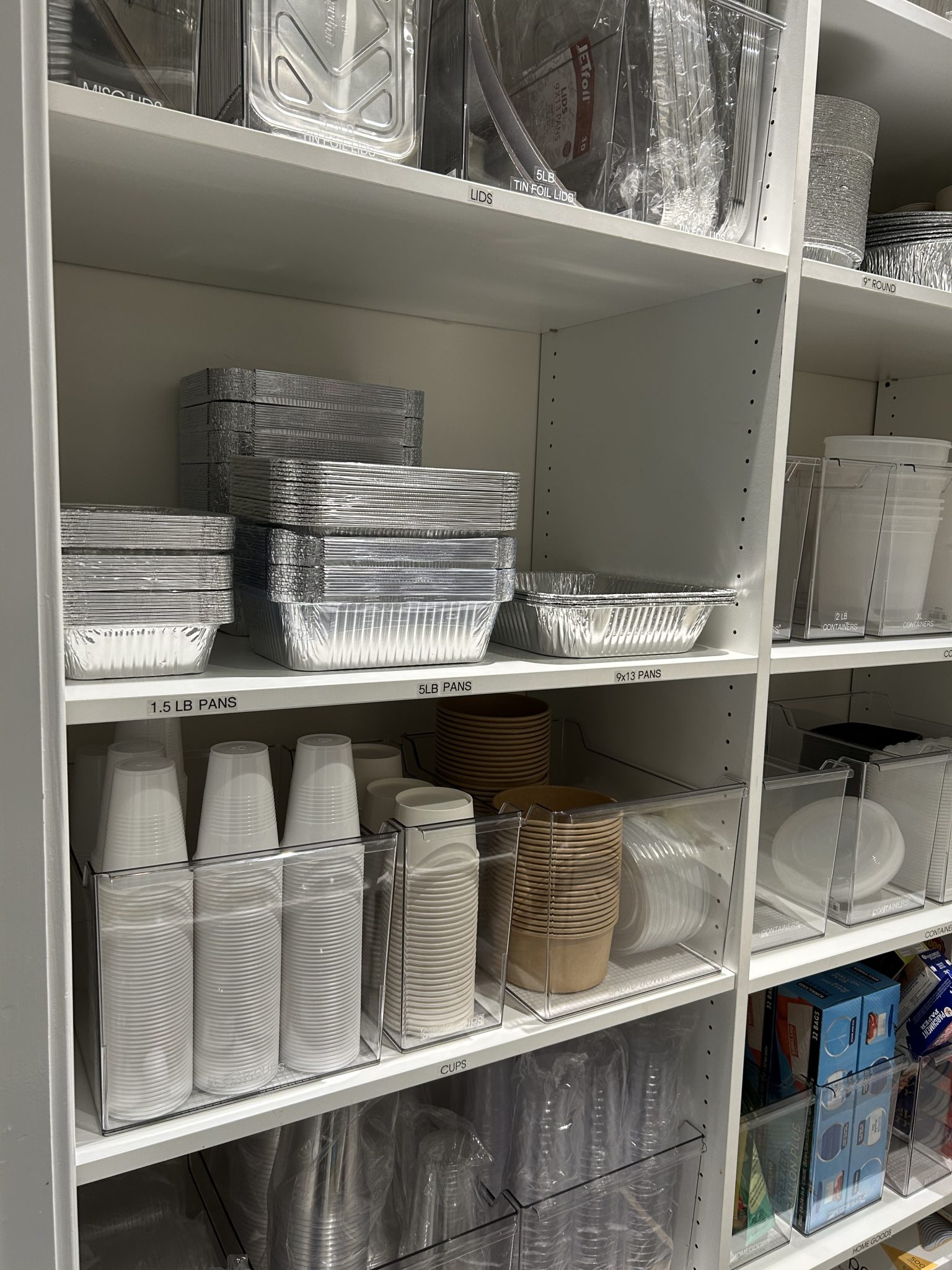
Containers get purchased. Takeout containers get saved. Extras get added before Pesach. And little by little, the collection grows.
At some point, the cabinet stops feeling functional and starts feeling frustrating.
That’s usually a sign that it’s time to pull everything out, match the containers with their lids, and see what you’re actually working with.
The container with no lid.
The lid with no container.
The one that’s slightly warped but somehow keeps making its way back into the cabinet.
The collection of takeout containers that quietly became permanent residents.
Suddenly, it’s much easier to see what’s actually being used and what’s simply taking up space.
For many people, this is where a surprising amount of space opens up.
Often, the issue isn’t the cabinet at all. It’s simply that there are more containers than the space can comfortably hold.
The goal isn’t to fit as much as possible into the cabinet.
The goal is to make the cabinet easy to use.
A Home for the Lids
Once you’ve edited the collection down to what you actually use, the next challenge is usually the lids.
Most people’s instinct is to keep containers with their matching lids attached. On paper, it makes perfect sense.
In reality, it usually creates large, awkward stacks that are difficult to access and even harder to maintain. The moment someone needs the container at the bottom, the entire stack starts to fall apart.
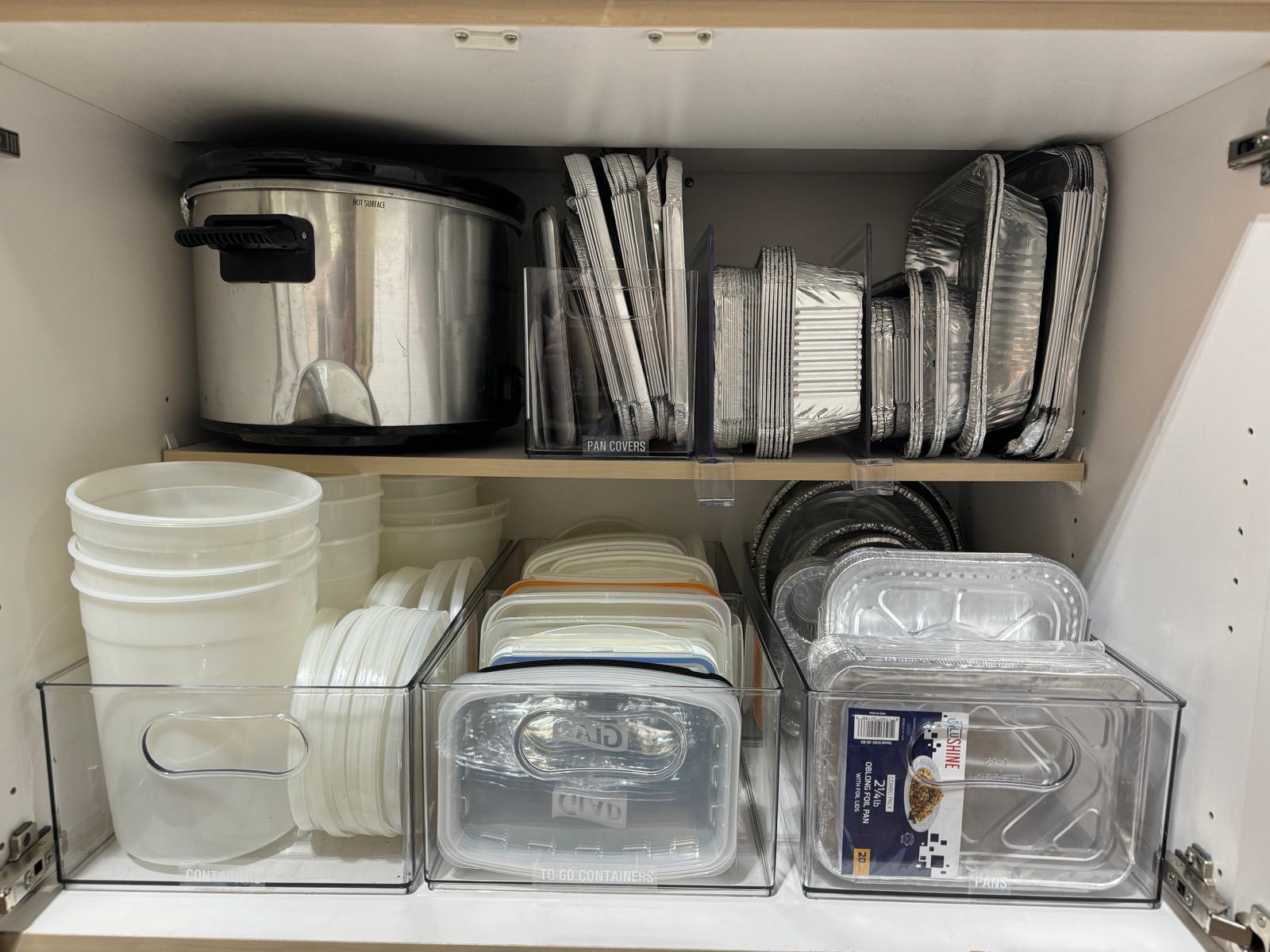
Instead, I recommend stacking containers by size and storing the lids separately nearby.
There are plenty of ways to do this, and the right solution often depends on the space you’re working with.
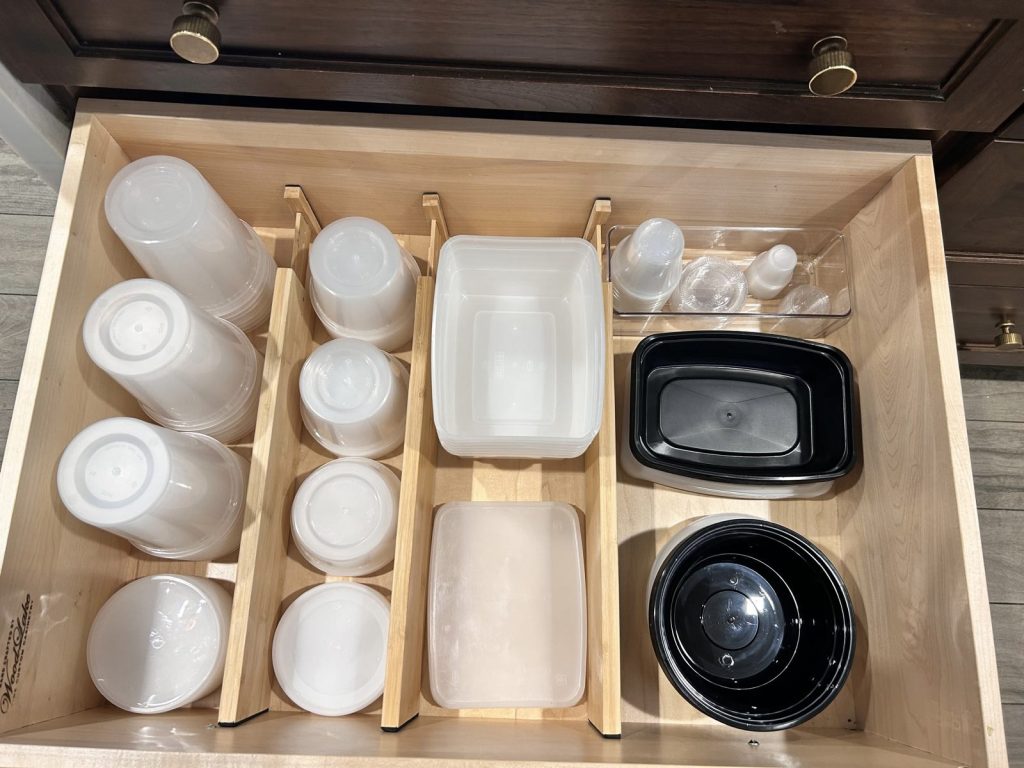
Drawer dividers work particularly well in deeper drawers, creating natural sections and helping keep lids from shifting around.
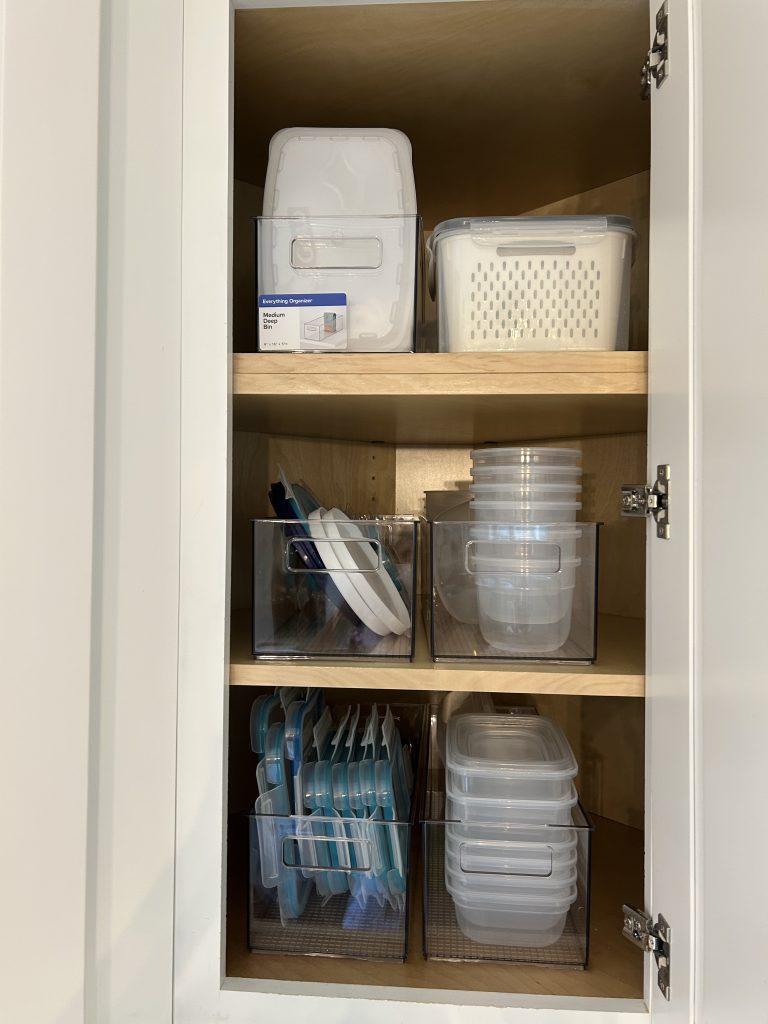
If you’re working with cabinets, it’s a little more challenging but bins are a simple option. A bin can be used to separate different sizes of lids, create zones for lids and containers, or simply provide one designated place to toss the lids so they stay contained and easy to find.
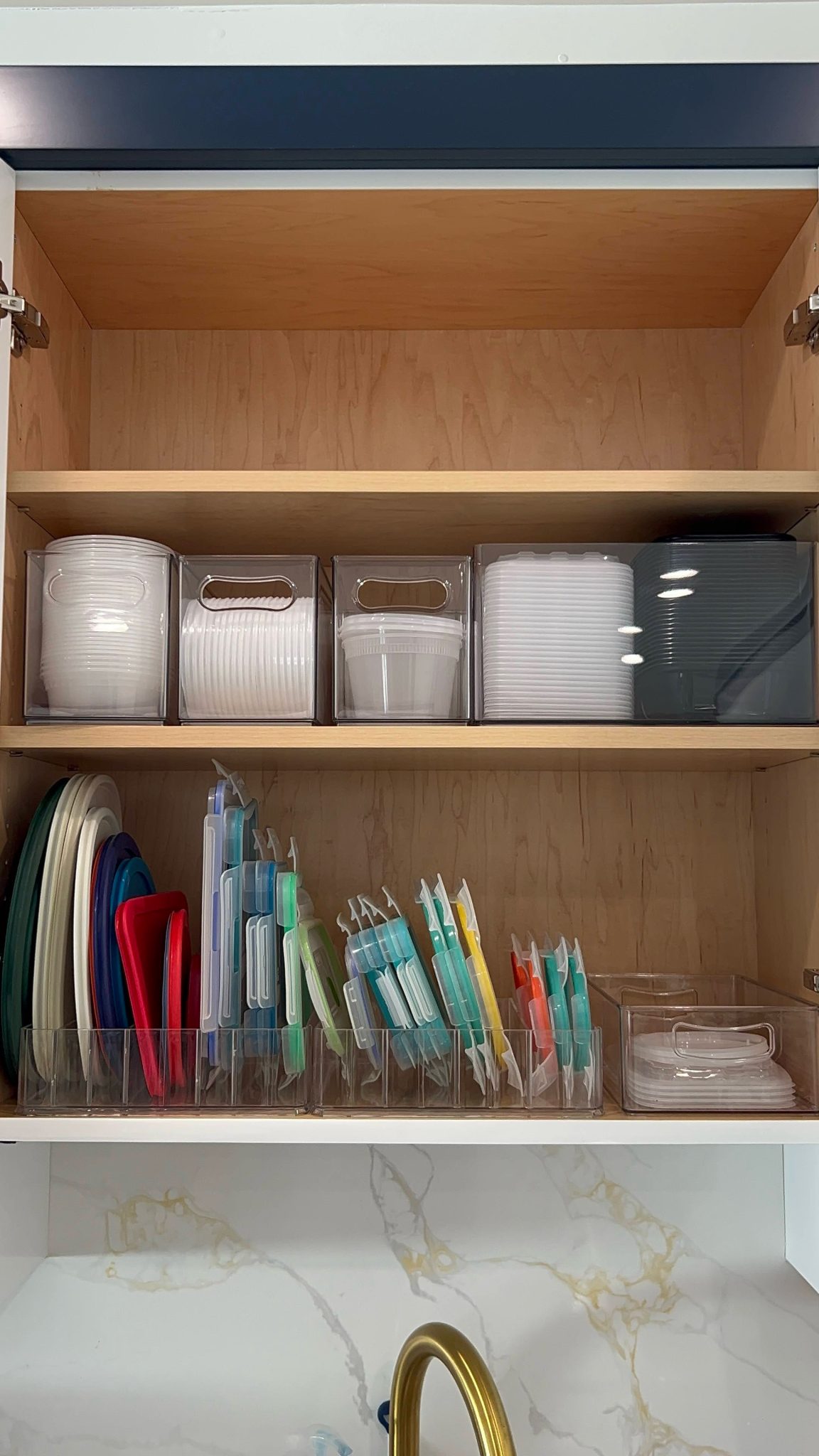
An adjustable lid organizer is a viable option if you use reusable containers of different sizes. Similar to a pot-lid organizer, it allows lids to stand upright and remain easy to see.
Real-Life Organized
Not every organized container cabinet looks the same.
I’ve seen beautifully organized container cabinets with matching sets, labeled bins, and custom organizers. I’ve also seen perfectly functional cabinets filled with containers collected over many years.
Both can work.
The goal isn’t to have a picture-perfect container cabinet.
The goal is to have a cabinet that works for you.
If you can find what you need, find the matching lid without digging through the entire cabinet, and put everything away without a stack of containers toppling over, you’ve created a successful system.
That’s what real-life organized looks like.
Not perfect.
Not magazine-worthy.
Just practical, functional, and easy enough to maintain.
Final Thoughts
The container cabinet is one of those spaces that tends to get out of control little by little.
The good news is that it usually doesn’t take much to get it back on track.
A quick edit, a little structure, and a workable system can completely change the way the cabinet functions.
And unlike some organizing projects that feel overwhelming before you even begin, this is one that can often be tackled in an afternoon.
You got this! Happy Organizing
– Devorah








|