

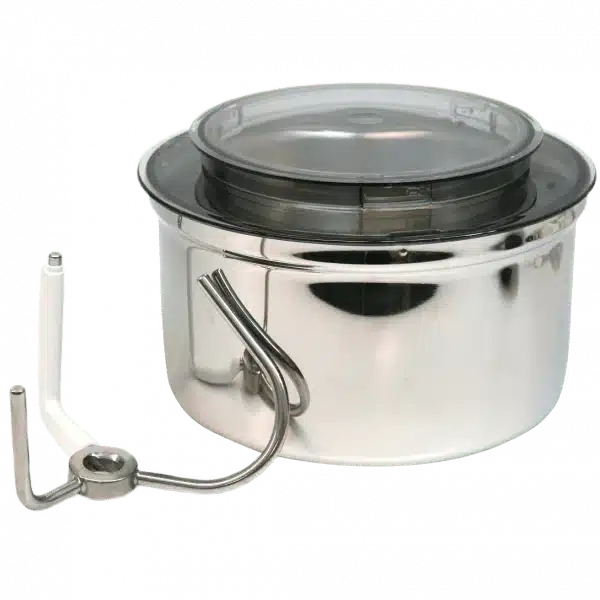
We’re finally breaking down the difference between the classic white Bosch bowl and the stainless steel challah bowl. Read the run-down here.
For my first 8-ish years married, I didn’t make challah. There! I said it! A perfectly capable and respectable grown woman who bought challah, every week. I was perfectly content making the fish, soup, chicken, and kugel, and letting my local grocery store make the challah.
So, what changed? I was making a shopping list for a 3-day Yom Tov, and finding myself overwhelmed by the math. How many challahs would I have to buy for 6 meals? Would they even taste good three days later? It was time, I decided, to grow up. My sister-in-law gave me a recipe that she promised was fool-proof, I took out my biggest mixing bowl, and got baking. You know the rest of the story, right? How thrilled my family was, how I realized that I really loved baking challah, and how I haven’t bought challah since?
Yes, I’m a cliche.
My first two years of baking challah, I did it by hand. I hadn’t received a challah machine when I got married, then I didn’t need one because I always bought challah. Once I started baking, I got used to doing it by hand and found it a lot harder to justify the expense of a machine and the space (minimalism, always!) it would take up.
When my elbows needed a break, I finally hit ‘buy now’ on the Bosch; I was baking often enough that I was ready to streamline the process. I checked with the team: did I need the challah bowl too? The consensus was to start with the classic machine and add the challah bowl on eventually.

So for the first few months of making challah in the Bosch, I used the white machine with the white bowl. It was SO MUCH EASIER than kneading the dough by hand! Baking challah became so much easier: it was easier to bake, easier to clean up, and most importantly, really saved time. I found that when using the white Bosch with the classic white bowl I did need to pause kneading a few times, open it up, and take out and reposition the dough to give it a more even knead.

Eventually, I decided to buy the stainless steel challah bowl. Why? I was baking challah often enough that I wanted to see the difference between the bowls for myself. I wanted the process to be as easy and seamless as possible, and wanted to see if using the stainless steel challah bowl would make a better dough.

The main difference between the two bowls is that the classic white bowl has the dough hook on top of the machine with a center column and the challah bowl has the dough hook on the bottom with no center column.
Practically? With the challah bowl, I didn’t have to stop, take off the top, take out the dough, and reposition it throughout kneading it. I left it alone and cleaned up the rest of the baking-challah-mess while the dough got a much more even knead.

It’s designed for bread, so the bottom drive dough hooks aren’t intimidated by your dense challah dough the same way that it sometimes seemed the top drive dough hooks were.
Important to note! This bowl doesn’t ‘lock into’ the mixer, so if you’re trying and trying and it’s not working, it’s not you! It works super well but without that ‘click.’
Here’s the bottom line: Do you need the stainless steel bowl? It depends. How often are you baking? When you’re baking, how often do you need to reposition the dough? Is the process easy enough, or do you want your dough more even with less effort? Personally, I’m excited to have a way to make baking challah even more streamlined. With the bottom drive stainless steel bowl, I can really set it up and let it knead, no extra work required.
Also, while some have made challah with the white bowl for years, for others, the dense dough blows out the motor and repairs cost almost as much as a new machine. I haven’t had that experience, because I hadn’t been baking for long enough. With the price of the bowl being half the price of a completely new machine, though, perhaps it’s worth taking the chance.









|