

The one thing only you can give your child is the one thing they need to blossom in life. Love.
One evening in June of 2017, I walked into my daughters’ bedroom to catch a glimpse of them before I turned in for the night. I saw two angelic little girls, heads tilted to the side, hair dangling off the bed, chests rising up and down, up and down, as they slept peacefully. And the one thing I wished they felt deep in their bones is the one thing I whispered in their ears while fixing their covers: “Mommy loves you.”
As much as I know how important it is for children to absorb this message from their early youth, I receive the most powerful reminders of this in the emotional coaching work I do with adult women. On that evening, I had just come up from the room where I sat with two women in back-to-back sessions, each one with her own story, her own journey, but both with the same underlying pain: I don’t feel good enough. I never felt good enough for my mother. I don’t feel that my mother loves me just as I am.
Although part of our growing up work is taking responsibility for our own happiness, now that I was watching the rise and fall of my daughters’ chests, I wondered about my own parenting. We mothers invest our heart and soul in raising our precious children. From morning to night and beyond, they are the focus of our lives. Before carpools, after, and in between, our lives revolve around the delicious human beings Hashem has chosen to place in our care. Still, things happen. A comment said in a moment of tension, stress, or disappointment, a harsh gesture expressed in anger—our children are so, so delicate, their emotional world so raw and absorbent.
Can we ever be careful enough? We can’t. But just as our children are human, so are we. By virtue of our humanness, we will err. And that’s okay. But for all the other times, when we are in a right state of mind and our heart is open toward our children, the most important message we can impart is how much we love them. It’s this one message that they will carry in their heart through adolescence into adulthood that will empower them to lead a life of happiness, confidence, and connection. While this is a feeling they absorb through our actions and subtle messages, it’s also important for them to actually hear us say it to them. And so, as I walked out of my girls’ bedroom that evening, the thought struck me, “Wouldn’t it be nice if I could read my kids a book about this at bedtime? Wouldn’t it be nice for them to fall asleep with cozy thoughts of love and happiness, secure in the knowledge that Mommy loves them?”
And I got to work. That evening, I sat and wrote, line after line, cutting, pasting, writing, deleting, telling the story of my heart on paper (er, screen). Wow, I thought as I wrote, we moms do so much for our kids. We express our love in so many ways. Why not reiterate it for them? Why not give them the good feeling that they’re being cared for and pampered all day long by the one person in the world who loves them more than they can imagine?
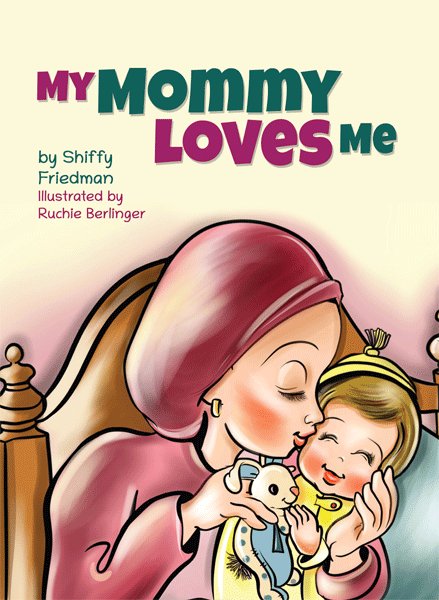
On that night, the first draft of My Mommy Loves Me was born. The next morning at breakfast, when I was still feeling all fuzzy inside, I told the kids that I had a surprise for them at bedtime: I wanted to read them the draft, to watch their eyes light up as they hear, in fun poetry, the many things Mommy does out of her love for them. But something happened in between—one of my daughters broke a rule, which meant she would be getting a punishment. And she very vocally let us all know that she wasn’t happy about that. There was crying, stomping, “You’re such a mean Mommy” talk and all that stuff that had the potential to snuff out all that fuzziness I’d felt just a few hours before. I wondered how the book would go over with that disgruntled kid. But a promise was a promise, and so, when she was all tucked in, I started to read. “No matter what I do, No matter where I go, There is one happy thought, I always feel and know. It makes me smile wide; It fills my heart with glee. I feel really special… ‘Cause my mommy loves me!”
When I finished reading, my daughter was quiet for a long moment. Then, she looked at me and said, “Even though I hate when you punish me, you do it because you love me. Right, Mommy?” And so, that night, I knew there was something I needed to add to the book that would become a sacred part of our bedtime ritual: the not-so-fuzzy part of parenting, but the part that expresses our love to our children just as much. Whether it’s making them eat the food they’d rather trade in for candy or go to bed when they still want to play outside, even the things that don’t feel good in the moment are just as much an expression of our love for them.
Pointing out the many wonderful deeds we do for our children is just one way to express how much we love them. Here are some more ways we can impart this vital message:
*Surprise them “just because.” This could be by picking up one child at a time earlier from school and spending a half hour or so together doing their favorite activity, or buying something we know they like “just because I was thinking of you.”
*Prepare their favorite dishes. Of course, point out, “I cooked this today because I love you and I know you really like this.” I like to ask one kid on a random morning, “What would you like for supper tonight? I want to make something you love.” They love asking, “Why?” They know what’s coming 🙂
*Spend 10 minutes of time alone with each child every day. This tip, which I learned from Rebbetzin Spetner (she still keeps up this practice, more or less, with her thirteen married children), may be more challenging to implement but is certainly worthwhile. It can be anytime: while you’re waiting together for the bus or carpool in the morning, while you’re cooking—calling one child over and asking them for their company, during bath time, or, of course, at bedtime. The reason the 10-minute chunk is so important is because we want our children to feel that Mommy is totally there for them, that it’s not a rush-rush interaction. If they get used to the idea of having 10 whole minutes together (almost) every day, they develop this sense of security. It’s interesting to observe how they end up “saving” stuff they want to share for this time.
*Join the Drop the Phone initiative! While quality time is important, quantity is equally so. We can’t foster a relationship from 10-minute interactions, even if they happen daily. Rather, the more time we spend being present to our children’s lives, the more they feel that they’re a priority in our life.
*As I’ve seen in my work with adults and in my own life, while it’s important for children to grow up feeling loved—all those happy memories of the good times we spent together—it’s even more important for our children to feel that we love them unconditionally. That is, not on any “Only if…” conditions, just “I love you for who you are.” This one’s the real challenge; there are no 1-2-3 steps here. Rather, we must first take an honest look at ourselves and see whether this is true or not. How do I feel when my child does something that doesn’t sit well with me? How much does it affect the way I feel about him or her? Am I living my life vicariously through my children, expecting them to be or become XYZ?
While being a parent may be accompanied by heartache or frustration, for our love to remain intact is what unconditional love means. How forgiving are we? Being able to answer this question in the way we’d like usually involves looking inside ourselves, too, to see how forgiving we are of our own selves, how okay we are with our own humanness, our own imperfection. But even if we’re not there yet, we can certainly start with the technical steps of showing unconditional love—such as telling a child who brings home a dismal score, “What matters to me is that you tried your best. I love you just the same.” This could be followed by, “Is there anything I can do to help you do better?” But the practical part pales in comparison to the vital emotional component here. Other examples are not being hard on a child who ruined something, relating with kindness and understanding to a child whose appearance isn’t as we please, or telling a child who broke a rule (in all honesty), “It pains me to have to punish you, but I’m doing this because I love you and I want you to learn to live your best life.”
This message must be conveyed in no uncertain terms also to those children who do well, the “easy” ones in the bunch. They must hear that their parents’ love is not “because you’re our nachas machine.” The older a child gets, the more they need to hear and feel this: My parents love me no matter what.
In the merit of all the great things we mothers do for our children, may they all grow up feeling loved, cherished, and special.

Spread the Mommy love!
In the comments below, write one way in which you expressed your love to your child today. One lucky commenter will receive a free copy of My Mommy Loves Me, with a note from Shiffy.
Announcing the lucky winner of the free book! It’s Toby, who wrote: I gave my daughter a bracelet to wear and told her that when she looks at it wherever she is, in school etc…it should remind her “my mommy loves me always.” (Winner was chosen through a lottery.) A special thanks to every woman who contributed to this important discussion!
If you’d like to purchase the book, Israel Bookshop Publications is offering a 10% discount off the already discounted web price just for BCP readers! Go to www.israelbookshoppublications.com and enter Mommy10BCP at checkout.











|